
MARCH 2026
Cristina Nan
In this exhibition, the work of Cristina Nan, Professor at the Eindhoven University of Technology (TU/e), is on display. Her projects operate at the intersection of architectural design, computational design, and advanced robotic fabrication. Central to her research is a strong focus on process: rather than applying generic digital tools, she develops material-specific workflows in which design, simulation, and production are closely integrated.
Two of the projects presented here—the Ceramic Clay Vault and the Biotectonic Column—were developed under the supervision of Cristina Nan and architect Mattia Zucco at TU/e.
The Ceramic Clay Vault
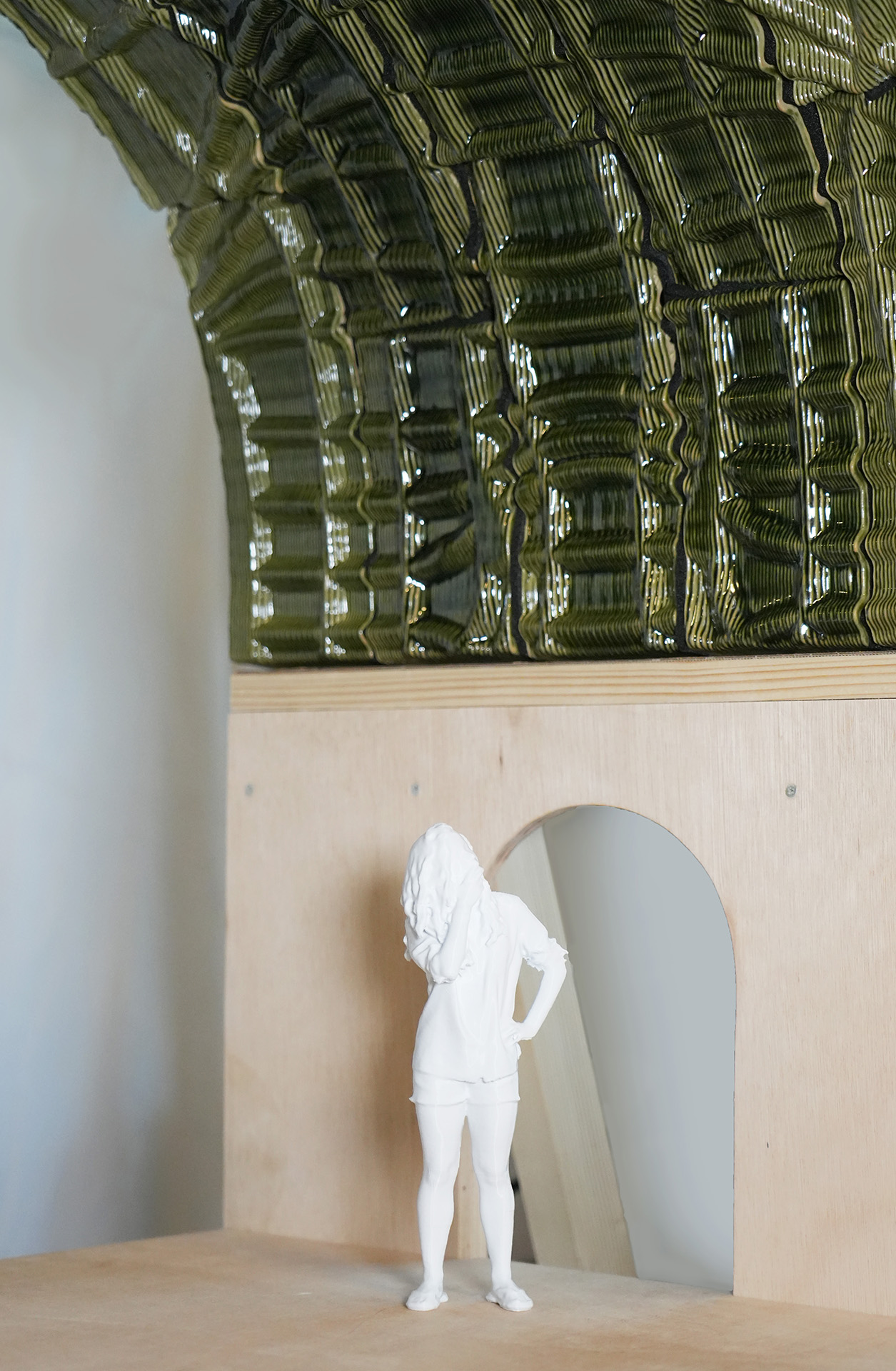
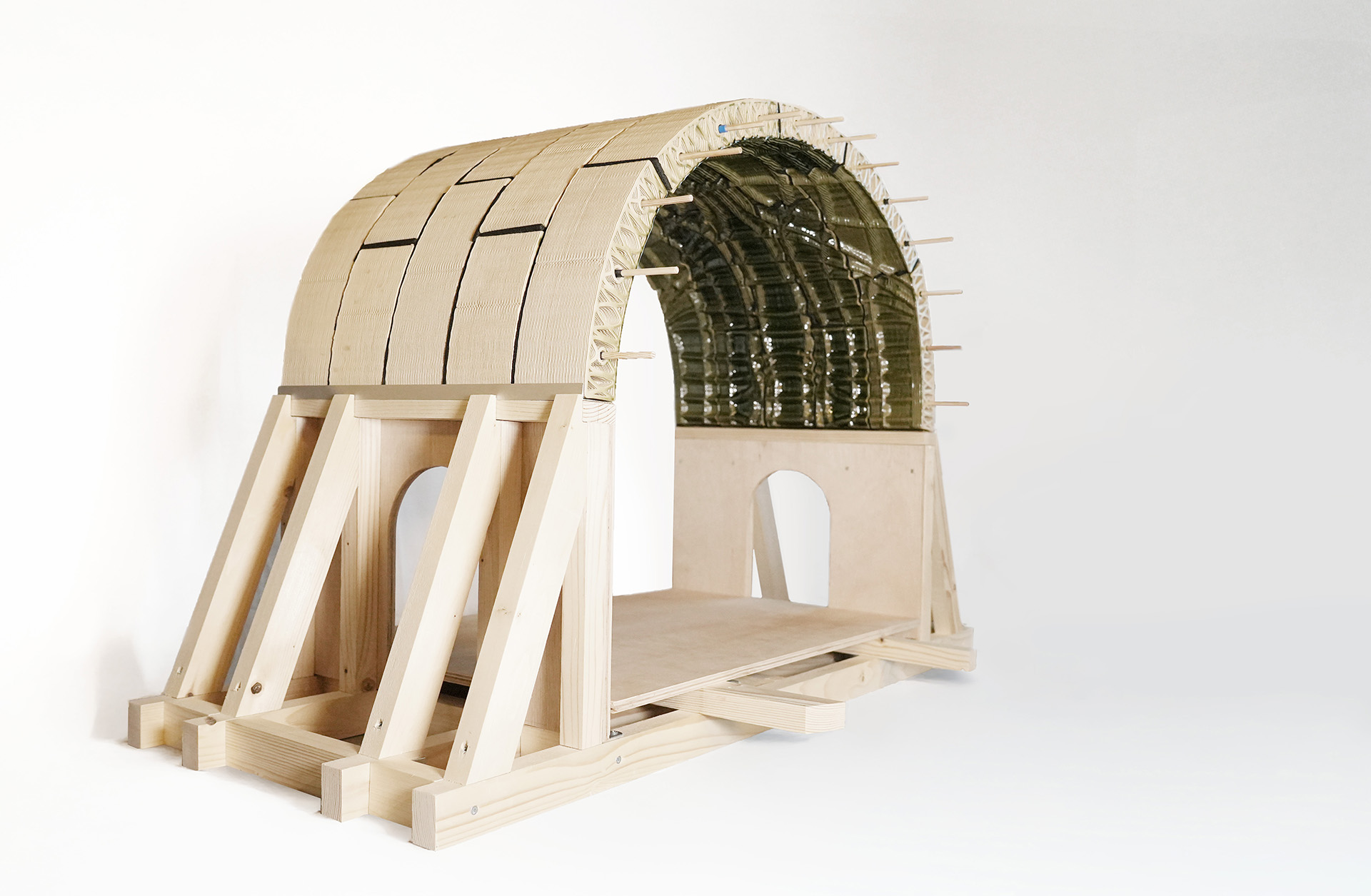
The 3D clay printed vault was developed by students Jan-Willem Melchers, Thijs Maas Geesteranus and Dena Khaksar under the supervision of Prof. Cristina Nan and architect Mattia Zucco at the Department of the Built Environment, Eindhoven University of Technology. The project investigates additive manufacturing with clay, exploring its spatial and ornamental potential in dialogue with the ruins of the Maxentius Basilica in the Forum Romanum.
Roman architecture represents a convergence of material knowledge, structural innovation and architectural expression, with the brick at its core. This project reinterprets the brick through computational design and robotic clay printing, transforming it from a standardized unit into a digitally informed tectonic element.
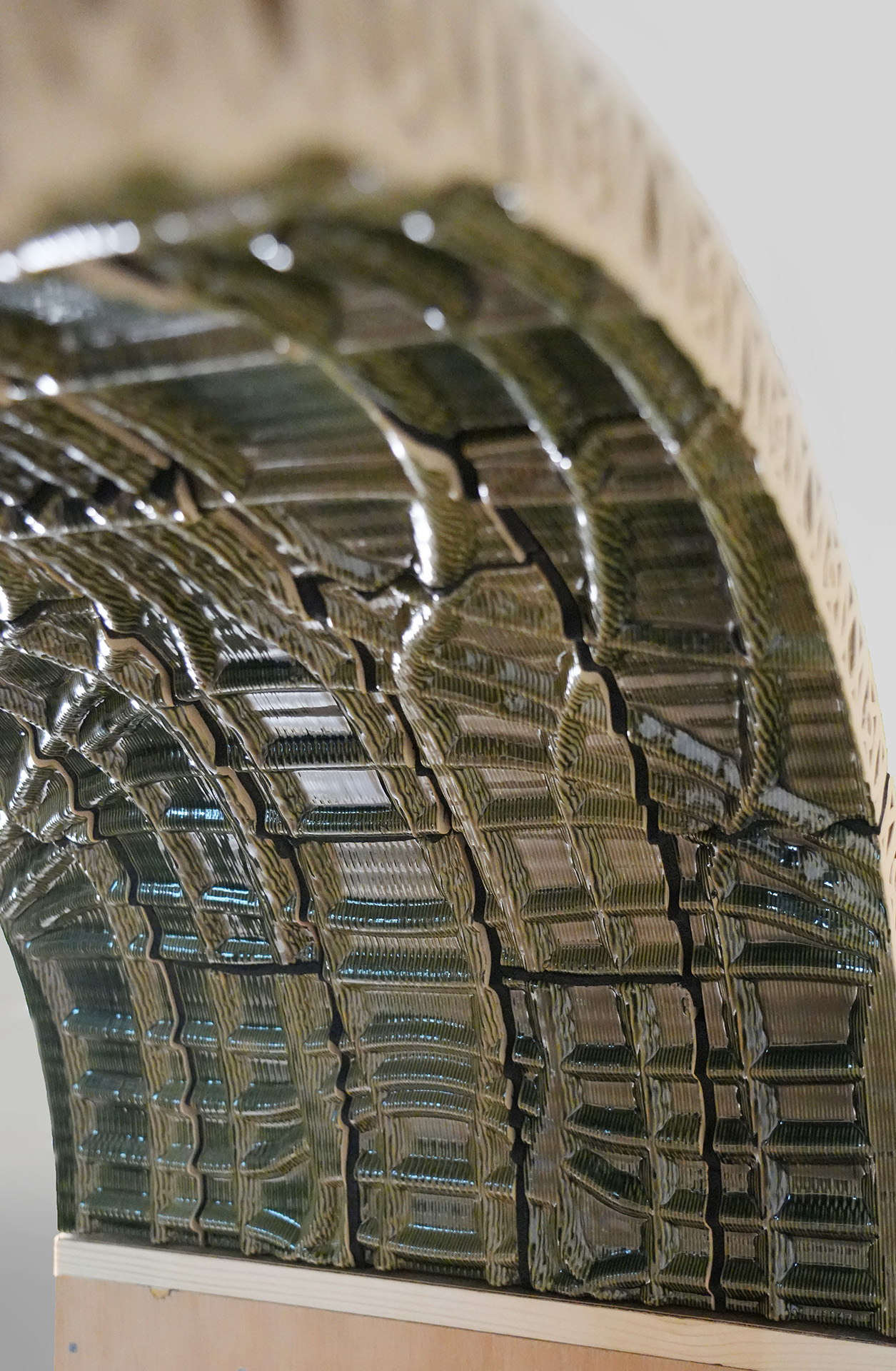
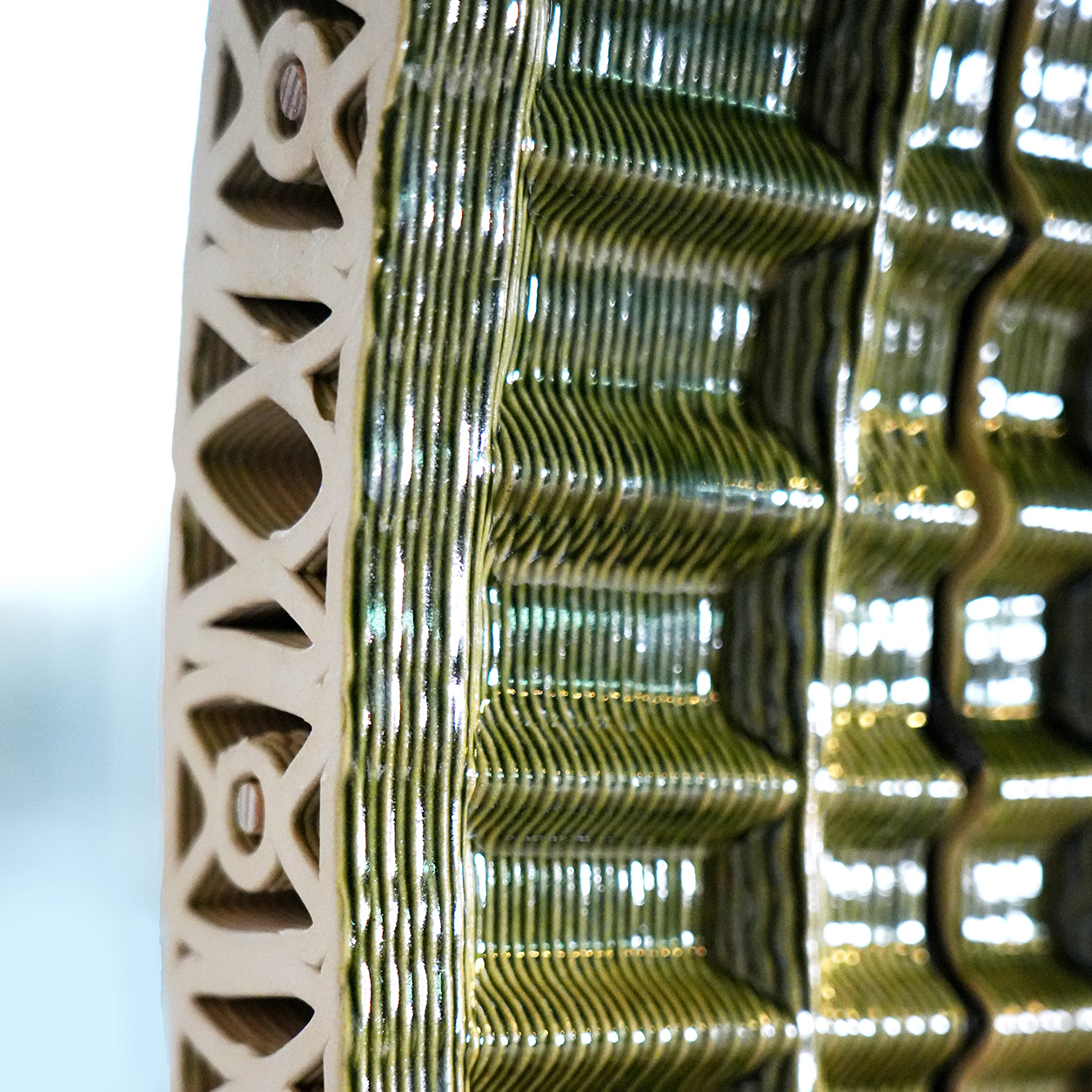
Focusing on one of the Basilica’s missing vaults, the research addresses both structural and material challenges. The hidden force-flow lines of the historic vault are revealed through three-dimensional tile geometries generated via structural analysis, simulation and computational tessellation. A key challenge was controlling clay’s behavior—its deformation during drying and its non-uniform shrinkage during double firing—while achieving the precision necessary for dry assembly. Through iterative calibration between digital modeling and physical prototyping, shrinkage compensation and deformation control were embedded directly into the robotic fabrication process.
The resulting scaled vault demonstrates how clay, when combined with computation and robotic production, can operate at the intersection of craft, tradition, innovation and sustainability.
Algorithm-Aided Tactility
This curiosity-led, interdisciplinary research is a collaboration between Assist. Prof. Cristina Nan (TU/e) and the UMC Utrecht. The fabrication partners for this project is Nagami, Spain. Within this project we explore the impact of tactile experiences embedded within architectural design on the development of children with autism spectrum disorder (ASD) of which 80% exhibit sensory processing problems.
We developed and are currently testing in a clinical context 15 different sensory wall panels with varying textures and three-dimensional patterns using sustainable and bio-based materials such as cork, sawdust, algae, pine wood and many others. This multidisciplinary research collaboration will foster innovative thinking and approaches to understanding the complex relationship between autism, tactility and design.
The Biotectonic Column
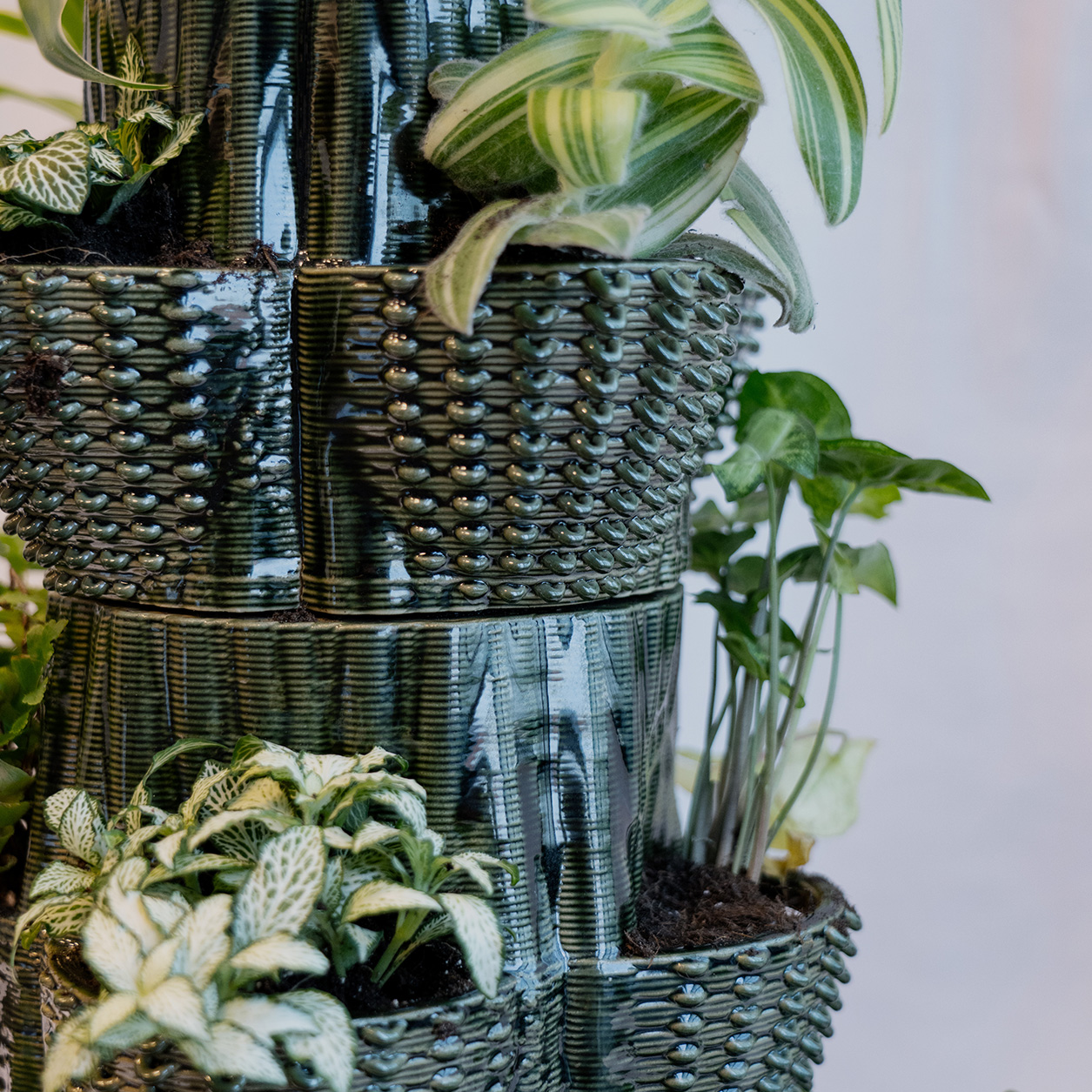
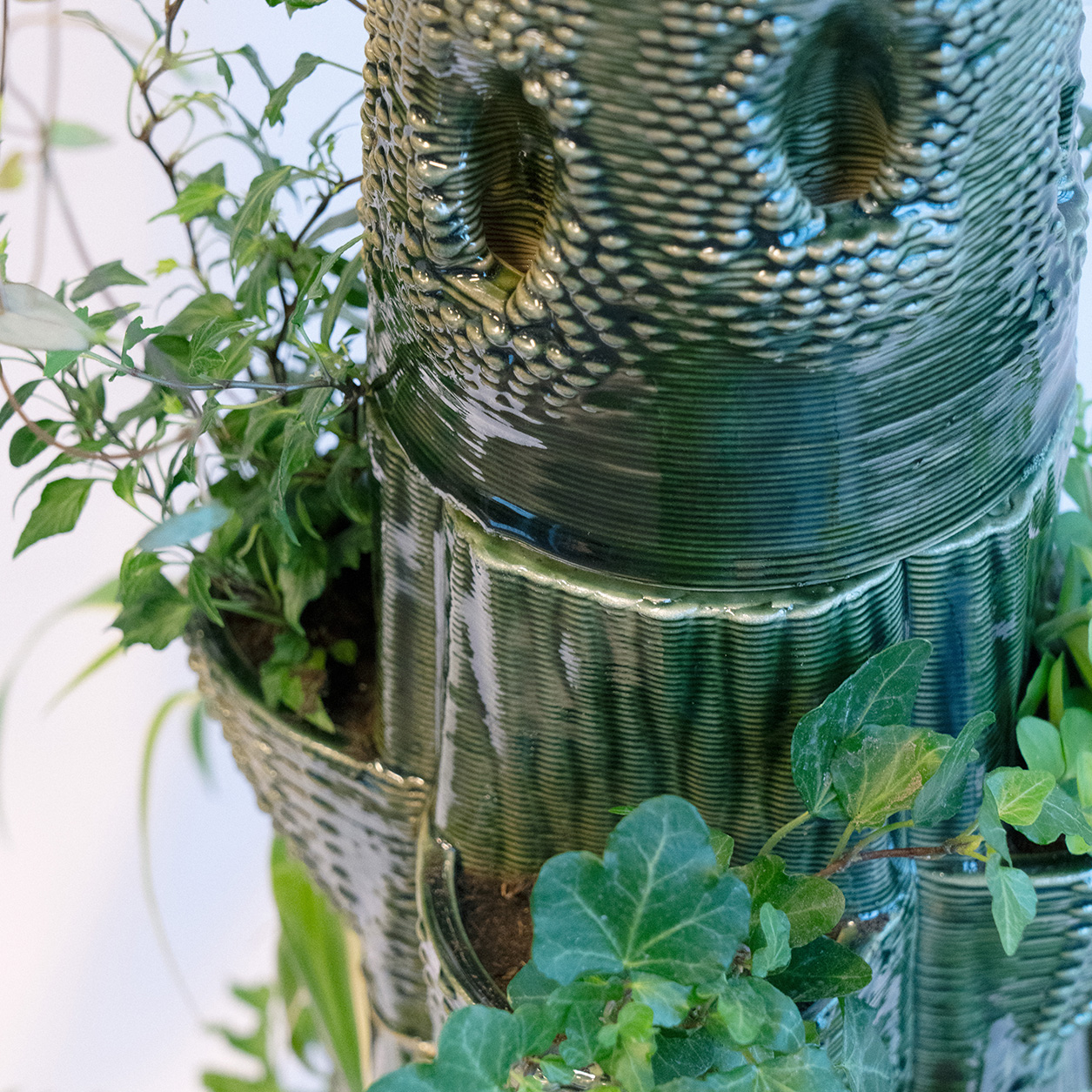
The Bio-Integration Column is an architectural proto-structure developed by our student Nikolett Asvanyi, part of the Computational Concrete Columns-Series supervised by Prof. Cristina Nan and architect Mattia Zucco at the Eindhoven University of Technology. Anchored in a research-led master project, the column was fabricated as a full-scale structure.
The project explores an alternative design logic for 3D-printed architecture—one where modularity and colour take centre stage. In this research we take on a new tectonic logic imposed on 3D clay printing, ornamentality is used as substrate for nature-inclusivity and biodiversity and the use of clay printing for modularity rather than the monolithic approach of printing in one go full-scale structures.
This segmentation—rooted in Greek and Roman architectural traditions of using stone drums to build columns—has been reinterpreted through robotic fabrication and algorithmic design.
The result is a column that is not only structurally stable but also reconfigurable, easy to assemble and disassemble, and highly circular in its lifecycle.
ABOUT THE ARTIST
Cristina Nan
Cristina is Assistant Professor at the Eindhoven University of Technology, since July 2020. Prior to this, from January 2016 til June 2020, Cristina was Assistant Professor in Design and Digital Fabrication at the Edinburgh School of Architecture and Landscape Architecture at the University of Edinburgh and since 2019 International Director of the Edinburgh College of Art, University of Edinburgh. She finished her architecture studies at the Technical University of Munich in 2010 and received her PhD in architectural robotics from the HafenCity University Hamburg in 2015. Additionally she studied at the University of Bath and the Institute of Advance Architecture of Catalonia IAAC in Barcelona.
Her work has been widely published and exhibited. The project Minibuilders, a project hosted at IAAC and based on a series of mini-robots, has been covered by the international press. Her work has been exhibited at the Biennial Venice (2023; 2025), Dutch Design Week (2022; 2023; 2024; 2025), FormNext at the Frankfurter Messe, National Museum Scotland, Ecobuild London and Festival of Architecture in Montpellier 2019, winning with her team the People’s Choice Award for the parametric installation Le Papilion D’Or.